If you’ve ever thrown a ball into the air, calculated the optimal area of a physical space, or marveled at the curve of a satellite dish, you’ve encountered the real-world magic of parabolas.
At the heart of these curves is the quadratic equation, a fundamental concept in algebra that translates beautifully into geometry. But staring at a static formula rarely paints the full picture. Let’s break it down and see exactly how it works.
The classic quadratic function is written as:
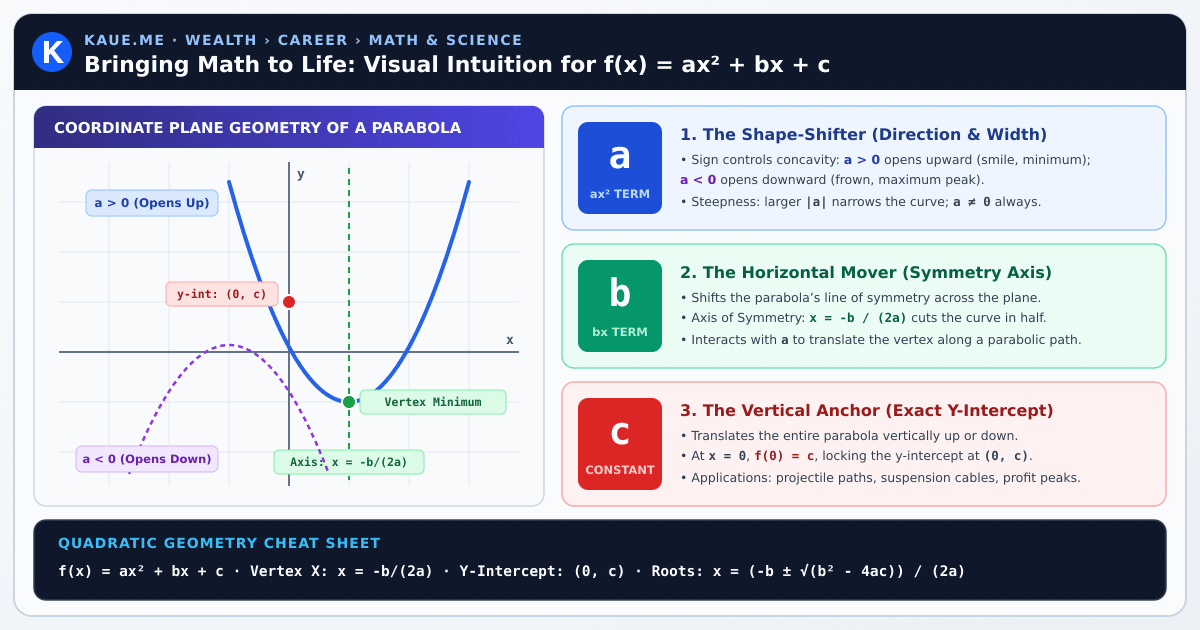
When we graph this equation, it creates a symmetrical U-shaped curve called a parabola. The letters , , and are known as coefficients. By changing these three simple numbers, we can morph, shift, and flip our parabola into an infinite number of configurations on the coordinate plane.
What exactly happens when we tweak these values?
The value of controls the direction and the width of the parabola.
The value shifts the parabola side to side, but in a slightly diagonal motion. It influences the location of the axis of symmetry—the invisible vertical line that cuts the parabola perfectly in half.
You can find the exact x-coordinate for this axis using the formula:
Changing essentially drags the curve horizontally across the graph, while interacting with .
This one is highly visual and straightforward. The coefficient represents the y-intercept. It tells you exactly where the parabola crosses the vertical y-axis.
For example, if our formula ends with a (meaning ), you know for a fact that the graph will intersect the y-axis at the coordinate .
Understanding the graph of goes far beyond passing an algebra test.
Engineers use parabolas to design suspension bridges, determining exactly how the cables will distribute weight. Physicists use them to calculate the trajectory of projectiles. Even businesses and economists use quadratic models to optimize pricing and find the point of maximum profit!
By playing with the sliders above, you aren’t just shifting a line on a screen—you’re manipulating the very variables that help us measure and build the physical world around us.Get notified when I publish new essays, book summaries, and practical guides on living well. No spam—unsubscribe anytime.
Get the curated offline edition of Kaue's Way of Life—a practical field guide to optimizing 🍏 Health, 💰 Wealth, ❤️ Love, and 🧘 Meaning.
Challenge yourself to a fast 60-second quiz across 🔢 Math, 🌍 Geography, and 💬 Language—with replays, ghost races, and global leaderboards.
Have a question, perspective, or suggestion? Share your thoughts below. Comments are powered by GitHub Discussions (ad-free and spam-free)—click Sign in with GitHub below to comment or react (creating a free GitHub account takes less than a minute).
Updated on Oct 11, 2026.
DISCLAIMER: The content on this site is for informational and educational purposes only and does not constitute medical, psychological, financial, investment, tax, or legal advice. The ideas, curation, and opinions presented here are my own and do not represent those of my employer. Book, lecture, and article summaries are independent educational commentary and remain the intellectual property of their respective authors. AI tools may be used to assist with editing, formatting, and synthesis; while every effort is made to ensure accuracy, errors may occur. PRIVACY: This site uses no tracking cookies; browser local storage is used solely to remember optional language and playback-speed preferences, and hosting logs on Google Cloud process visitor IP addresses, browser metadata, requested resources, page engagement, and referral sources for aggregate traffic statistics. Third-party services used for optional newsletter subscriptions (Mailchimp), comments (giscus / GitHub Discussions), and media downloads/streaming (GitHub) may process visitor IP addresses and cookies in accordance with their respective privacy policies.